How Do You Know if the Limit Exists
A common situation where the limit of a function does not exist is when the one-sided limits exist and are not equal: the function "jumps" at the point.
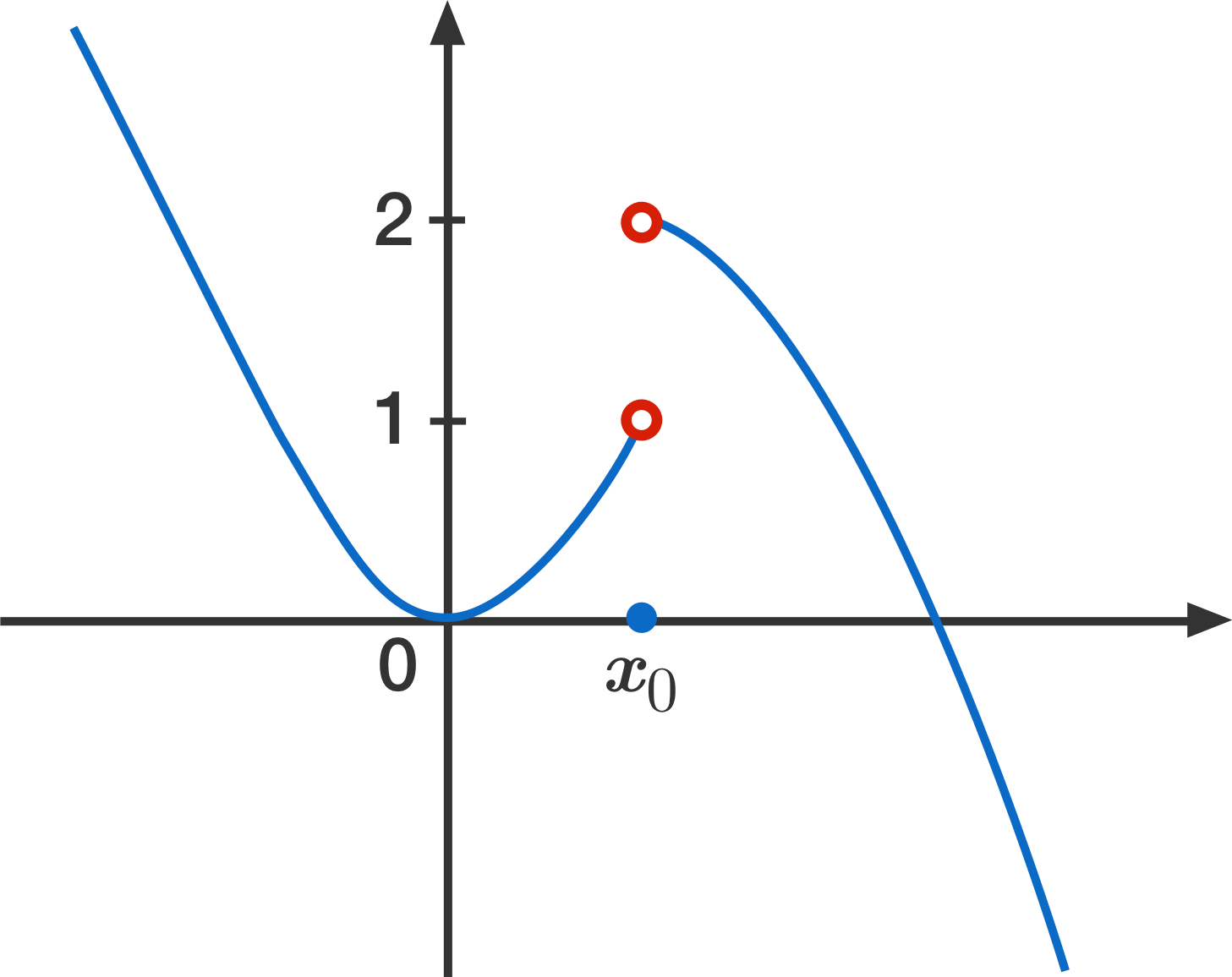 The limit of at does not exist. [one]
For the role in the movie, the i-sided limits and both exist, simply they are not the same, which is a requirement for the (2-sided) limit to be. This is usually written
where "DNE" stands for "does not exist."
Select one or more
Let then which of the following are correct?
Notation: denotes the flooring function.
Some other common state of affairs when limits do non be involves the part "blowing upwards" to or The graph is characterized by a vertical asymptote at
 The one-sided limits of at do non exist. [two]
While it is correct to say that and do not exist, in this example the limits are generally written every bit
This is the standard annotation that has the benefit of beingness more specific about the way in which these limits fail to exist. For the formal definitions, see the infinite limits section.
When the one-sided limits accident up in the same mode, this tin can be shortened to a unmarried two-sided limit, e.g.
So,
but it should exist emphasized that does not exist; proverb that information technology "equals " is just a way of describing why it does not be.
The third course of functions which give non-existent limits are the almost exotic. If does non jump or blow up at but does not exist, the general picture is that takes on multiple values which are far away from each other, even when its statement moves closer and closer to
The standard example is near
The function oscillates infinitely often as it approaches 0. [iii]
If were truthful for some and then the definition of limit would imply that at that place was an open interval such that the values of for in that interval were within, say, of But no thing how small might be, it would have to contain and for some sufficiently large Since and this is a contradiction.
All ; all Irrational ; all Irrational ; irrational No ; all No ; no
Let and be ii functions divers on by the formulas as described above.
For which does the (deleted) exist?
For which does the (deleted) exist?
Information technology is worth emphasizing that the above examples are all of functions that are defined at every point in an open interval around the indicate in question, except possibly for itself. There are other examples of functions which practice not have two-sided limits at considering this supposition fails.
does not exist for the unproblematic reason that is not defined in any open interval containing since its domain is
is an endpoint of the domain for [four]
- Alexandrov, O. Discontinuity. Retrieved September 12, 2005, from https://commons.wikimedia.org/wiki/File:Discontinuity_jump.eps.png
- Richards, One thousand. Rectangular hyperbola. Retrieved July 2, 2008, from https://commons.wikimedia.org/wiki/File:Rectangular_hyperbola.svg
- Thoma, M. Sin(1/x). Retrieved September 18, 2012, from https://commons.wikimedia.org/wiki/File:Sin%281x%29.svg
- Richards, 1000. Square root. Retrieved July ii, 2008, from https://eatables.wikimedia.org/wiki/File:Square_root_0_25.svg
deatheragethessid.blogspot.com
Source: https://brilliant.org/wiki/when-does-a-limit-exist/
0 Response to "How Do You Know if the Limit Exists"
Post a Comment