When Do Jacaranda Trees Get Green Again
This mail may comprise affiliate sales links. Please see my full disclosure policy for details
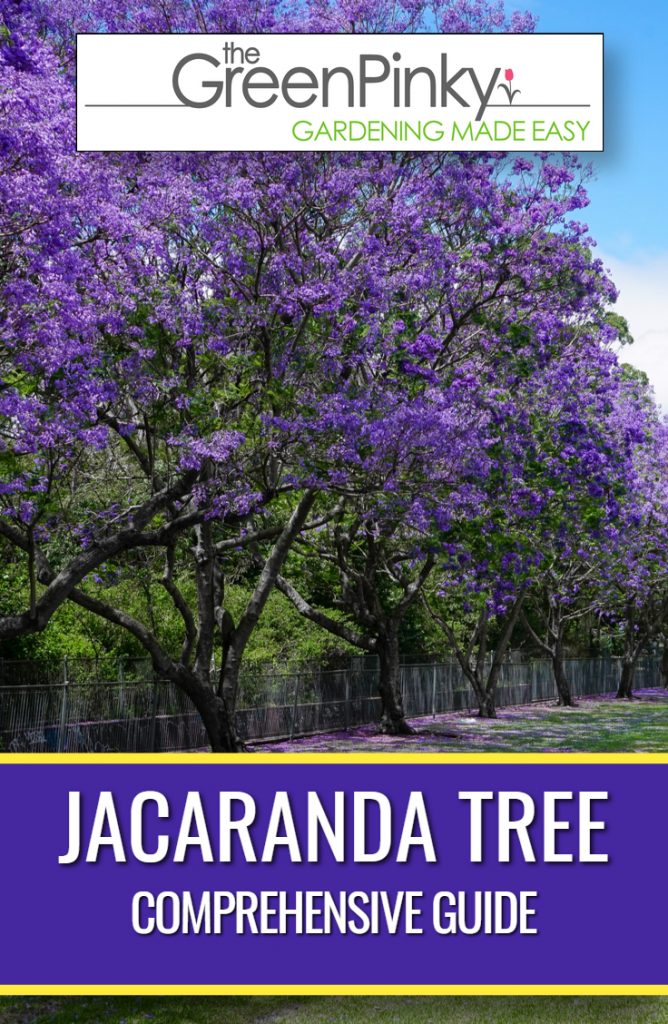
If yous are because adding some color to your landscape, look no farther than the jacaranda tree. Filling the leap sky with a deject of purple, information technology is a stunning sight to behold. It'southward easy to see why this beauty is pop with gardeners in all tropical and subtropical areas.
Take some time to learn some of the proper trimming techniques for arborvitae. Bank check out our guide to preclude making mistakes.
The southern native is also called a fern tree. A close await at its long, feathery leaves explains why. Each leap, the soft-looking leaves are pushed aside by attractive, trumpet-shaped, long-lasting purple or pinkish flowers.
One time you lot run across a purple hue emerging, you know that bound has arrived. And who doesn't want to welcome a new growing season with all the fanfare information technology deserves?
If you're because adding a jacaranda to your landscape, read on for all the important details. Included below is everything from basic characteristics to how to promote healthy growth.
Full general Information
Jacarandas are subtropical and native to central and southern Due south America. Ordinarily chosen jacaranda or blueish jacaranda.
Although the genus contains numerous unlike species, Jacaranda mimosifolia is the most common. It's a popular and hardy tree cultivated in subtropical and tropical climates. Therefore, it'south hardy growing in USDA zones 9 through 11.
In fact, it's then hardy that southeastern Queensland, Commonwealth of australia considers the shrub an invasive species.
The woody plants are fast-growing, and their branches are oftentimes prone to breaking. Mature copse grow up to be about 40 feet tall and 60 feet wide.
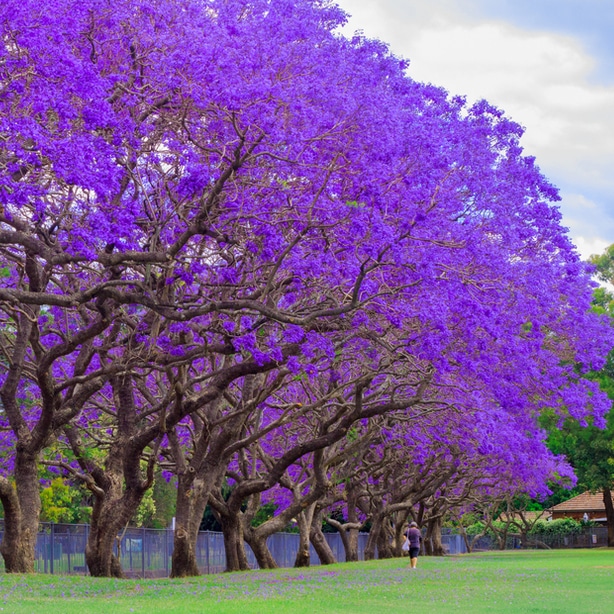
The species grows naturally into an open up, vase-like shape with a spreading canopy. There can be a single or multiple trunks. Graceful branches are filled with greenish, plumage-like foliage. During fall and winter, the deciduous leaves become yellow before dropping. In its warmest locations, the tree tin be semi-evergreen.
Despite the jacaranda'southward svelte dazzler, what sets it apart is its extravagant blooms. Spring through summer, the tree forms xviii-inch-long panicles. They make full with clusters of lightly scented, violet-regal or lavander, trumpet-shaped flowers. The cultivar "Alba" produces white flowers.
The flowers can fill the canopy with intense color before the foliage emerges in the bound.
The spent flowers form into round fruits that turn hard and brown when ripe. The fruit contains the plant's seeds.

Care Guide
When grown in their preferred climate and conditions, this species is a breeze to accept care of. Information technology doesn't accept much to proceed them healthy and happy in your yard.
Corporeality of Sun
The species prefers a location in full lord's day. It performs best when it receives eight to 12 hours of direct sunlight daily. However, saplings tolerate light shade.
Keep in mind that although a jacaranda tolerates growing in fractional shade, it will grow meliorate and flower more profusely in a sunny location. As well much shade means fewer flowers.
Immature saplings tin can be grown in a pot. If you demand to bring the potted plant within because of a cold-weather spell, place the pot in a sunny location, near a due south- or westward-facing window. Due to its fast growth and ultimate size, a sapling volition somewhen demand to be transferred into the ground.
Soil Conditions
This species prefers soil that drains well. Soggy soil can atomic number 82 to root rot, which will kill the plant. It will grow best and produce the most flowers when planted in sandy soil or loamy soil with good drainage.
If you lot are growing a sapling in a pot, use a light potting mix and make sure the pot drains well.
If y'all like flowering trees, you might too want to check out our weeping cherry tree guide.
Watering Frequency
Several factors influence the frequency and corporeality of h2o it requires. Climate, soil type, and season all play an important function. It's always best to h2o deeply. Saturate the soil to a depth of effectually ii feet.
If the species is planted in sandy soil, you can expect to water twice weekly, peculiarly if conditions are hot and dry. If the soil is loamy, look to water only once each week.
If your location is experiencing an peculiarly hot and dry summertime, you may have to h2o more frequently.
During winter, the jacaranda stops actively growing. This means you can cut back watering to monthly applications.
Water potted jacarandas when the top several inches of soil become dry. Stick your finger into the soil, and if it feels dry, apply h2o.
You tin can assist the soil conserve its moisture by using mulch. Spread several inches of organic mulch under the tree's awning. Just be sure to go on it pulled back several inches from the trunk to forbid pest and illness issues
Fertilization
Fertilize this species with a general-purpose blend for trees. May is ordinarily a good time. This plant does not need much extra nutrition, so one application per year is sufficient. Select a 10-x-10 fertilizer and employ it according to the parcel instructions.
Don't stress if you forget to fertilize. The plant is forgiving and oft thrives fifty-fifty in poor conditions. I missed feeding won't kill it.
Spread the fertilizer evenly under the tree's canopy. Lightly scratch information technology into the soil, and and then utilise water. Be sure not to barrel the production against the body to prevent burning.
If y'all have a young jacaranda growing in a pot, use a full general-purpose, water-soluble fertilizer blend. Mix and apply before watering. Apply in spring.
Pruning
Do any major pruning in fall and wintertime, when the plant is not actively growing. However, yous can remove cleaved, crossing, or diseased branches year-round. Unpruned trees with more than ane trunk develop a weak structure and are prone to splitting.
Pruning while the woody plant is yet immature is important Now is the fourth dimension to remove all but the healthiest-looking fundamental trunk. This will create a stiff structure. Trim all additional volunteer trunks to basis level as they sprout.
Prune to proceed major branches spaced apart and open. Never trim off more than one-fifth of the canopy, as that tin can weaken the tree.
For your plant to develop a strong structure and shape, prune at least every three years. Otherwise, splitting and breaking branches tin be a run a risk.
Be sure to use clean pruning tool blades when making your cuts. Yous don't want to transfer a disease or pest to the tree accidentally.
Pattern Ideas
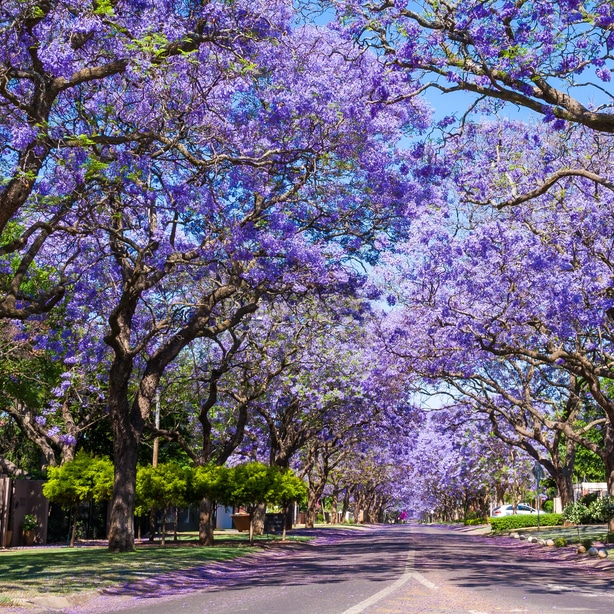
Jacarandas make gorgeous additions to any landscape, especially when they burst into bloom with either purplish or white flowers. They can brighten any m with non-stop color and add a tropical flair. In portions of California, they are used as showy street copse, filling neighborhoods with a haze of purple.
Jacarandas make great shade trees, offer dappled shade in an expanse with full sun. You can relax under the feathery foliage and beat the oestrus of a summertime solar day.
Because of its large size when fully mature, this plant works best in medium-sized to large yards. Their spreading awning can overpower a small mural.
Their graceful and flowing branches make it an attractive improver planted past a patio or porch. It as well is quite showy when situated in a place where it can exist an elegant canopy over a walkway.

Design Considerations
When selecting a location for this species, you need to consider several factors.
Don't plant information technology too closely to a construction or powerline. Because the forest is prone to breaking, falling branches might cause damage if they hit office of a building or pole.
Between falling blossom petals, leaves, and fruit, the tree can be quite messy. So don't institute it most a swimming pool. Otherwise, you lot'll accept to continually worry near the pool filter clogging up. And rather than taking a dip in the absurd h2o, you'll be cleaning upwards the area effectually the pool.
Jacarandas have a vigorously growing root organisation. Therefore, you don't want to institute the tree likewise shut to water or sewer lines or a sidewalk. The roots can cause damage to the lines and elevator the sidewalk.
Companion Plants
You can choose from a diverseness of plants that grow well equally companions. Whether y'all're looking for low-growing ground covers, shrubs, or another tree, in that location's plenty to select from.
Consider a plant that thrives in the aforementioned conditions as the jacaranda and perhaps one that adds colour when the tree is no longer in bloom.
Companion Copse
A few trees that compliment jacarandas are:
- Imperial Poinciana (Delonix regia) – Red flowers in early to late summertime.
- Yellow Poinciana (Peltophorum pterocarpum) – Xanthous flowers in summertime to autumn.
- Orchid Tree (Bauhinia spp.) – Blood-red, white, purple, yellow, and pink flowers year-round.
Companion Shrubs
Shrubs that work well growing with jacarandas include:
- Croton (Croton spp.) – Colorful evergreen foliage yr-round.
- Plumbago (Plumbago spp.) – Yr-round bluish flowers.
- Indian Hawthorn (Raphiolepis indica) – Evergreen producing white spring flowers.
Basis Covers
Some ground covers that compliment jacarandas include:
- Liriope (Liriope spp.) – Evergreen with green or variegated grass-like leafage.
- Bromeliads (Bromeliad spp.) – Evergreen producing flowers in various forms and colors.
- Boston Fern (Nephrolepis exaltata) – Evergreen with airy, feathery foliage.
Wherever you make up one's mind to plant your jacaranda and regardless of companions, it'due south certain to exist a showstopper.
deatheragethessid.blogspot.com
Source: https://www.thegreenpinky.com/jacaranda-tree-comprehensive-guide/
0 Response to "When Do Jacaranda Trees Get Green Again"
Post a Comment