Wat Is Depth in Terms of Measurement of Art
Depth of field (DoF) is i of the most important concepts in photography. Agreement what DoF is, and knowing what factors affect it, are things all photographers should master. Many photographers know that you can control DoF by adjusting aperture. Just did yous know that DoF is influenced by other factors too? In this article, I desire to explain in simple terms what depth of field is and talk about the means you can command it.
What is Depth of Field?
Depth of field is the distance betwixt the closest and uttermost objects in a photo that appears acceptably sharp. Now your camera tin can only focus sharply at ane point. Simply the transition from abrupt to unsharp is gradual, and the term 'acceptably abrupt' is a loose one! Without getting also technical, how you will exist viewing the image, and at what size y'all volition be looking at it are factors that contribute to how acceptably precipitous an prototype is. Information technology also depends on how good your vision is!
Scientifically, it is based on something chosen the circumvolve of defoliation. This involves more than physics than I'thou going to get into here! Spencer talks about it in his article "Hyperfocal Distance Explained." So bank check that out for more of the technical details if you lot are so inclined.
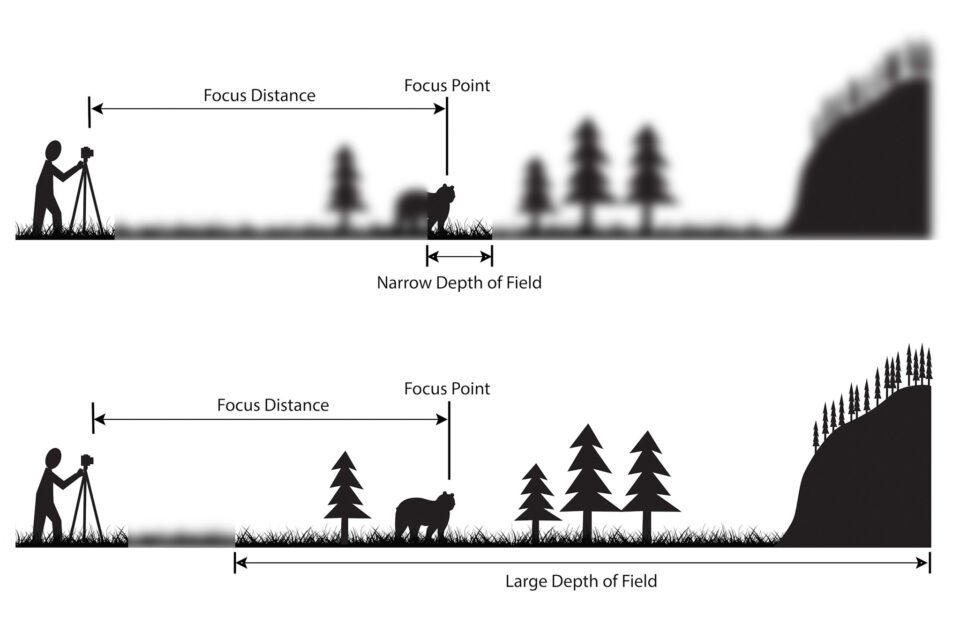
In these ii sketches, I have tried to illustrate what is meant by a narrow and large DoF. In a photograph with a narrow DoF, only a small slice of the image is in focus. Conversely, with a large DoF, much more of the scene is sharp.
Video Demonstration
Although this article has a lot of existent-world example photos, if you're the blazon of person who prefers to learn via video demonstrations, nosotros have filmed a complete depth of field tutorial that yous may notice useful. You tin can picket it here:
Photo Demonstration
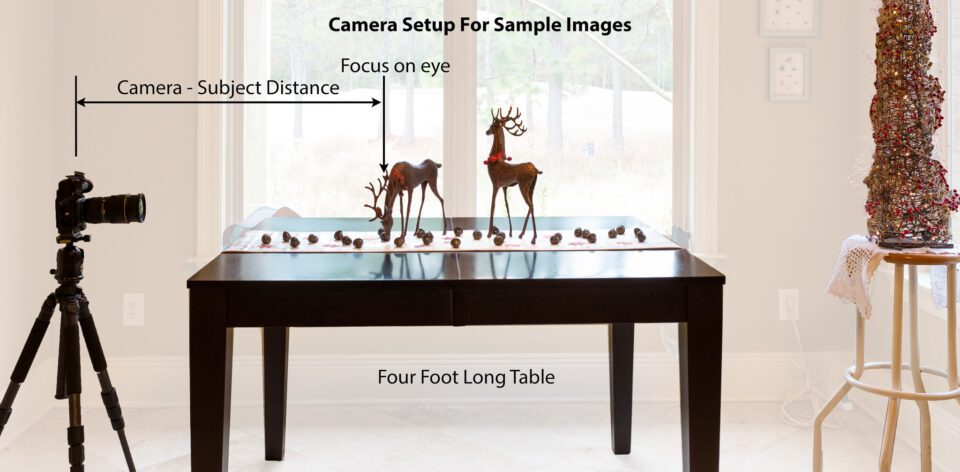
Now allow'due south show some example photos of how to change depth of field for a given scene. Earlier everything else, I wanted to testify you the setup I used to have the sample images in this commodity. Hopefully, this will give you lot a bit more than insight into the photos and a better experience for the distances between the objects I was shooting. To change the camera-subject distance, I moved my tripod closer/farther away from the props. All of the exam images were shot with the same camera, a Nikon D500.
Aperture
Aperture is the opening in your lens that lets light laissez passer through to the sensor. Recall of information technology as a pupil for your lens. It dilates to let more low-cal in, and contracts to restrict light when it is brilliant. Aperture is probably the first thing virtually photographers think of when they want to adapt the depth of field.
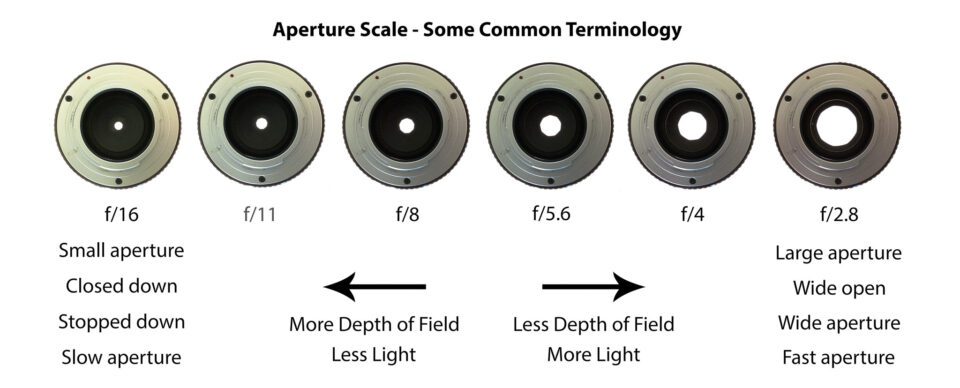
Large apertures, which correlate to small f-stop numbers, produce a very shallow depth of field. On the other mitt, small apertures, or large f-cease numbers, produce images with a big depth of field.

This image has a large DoF. I focused on the rocks nearly 5m ahead of me. The foreground rocks and the distant clouds are all in focus.

This image has shallow DoF. Here I focused on the boxing gloves. They are sharp, but the background is blurred.
Camera-Subject Distance
Another of import factor affecting depth of field is the distance betwixt the photographic camera and the subject. The shorter that distance, the smaller the depth of field. Have you ever tried to take a close-up shot of a flower or insect, but can't get the entire subject in focus, even with a small aperture? This is because the closer y'all are to your field of study, the shallower the DoF.
Look at these two sets of images. The camera-subject distance in the first group of pictures is ane.5m. After each shot, I stopped down the aperture. The second set has a focus distance of simply under a half a meter. Find two things. In each fix of pictures, every bit the aperture narrows, the DoF increases. In addition, for each pair of photos shot at the aforementioned aperture, in that location is more depth of field when the camera-subject altitude is greater.
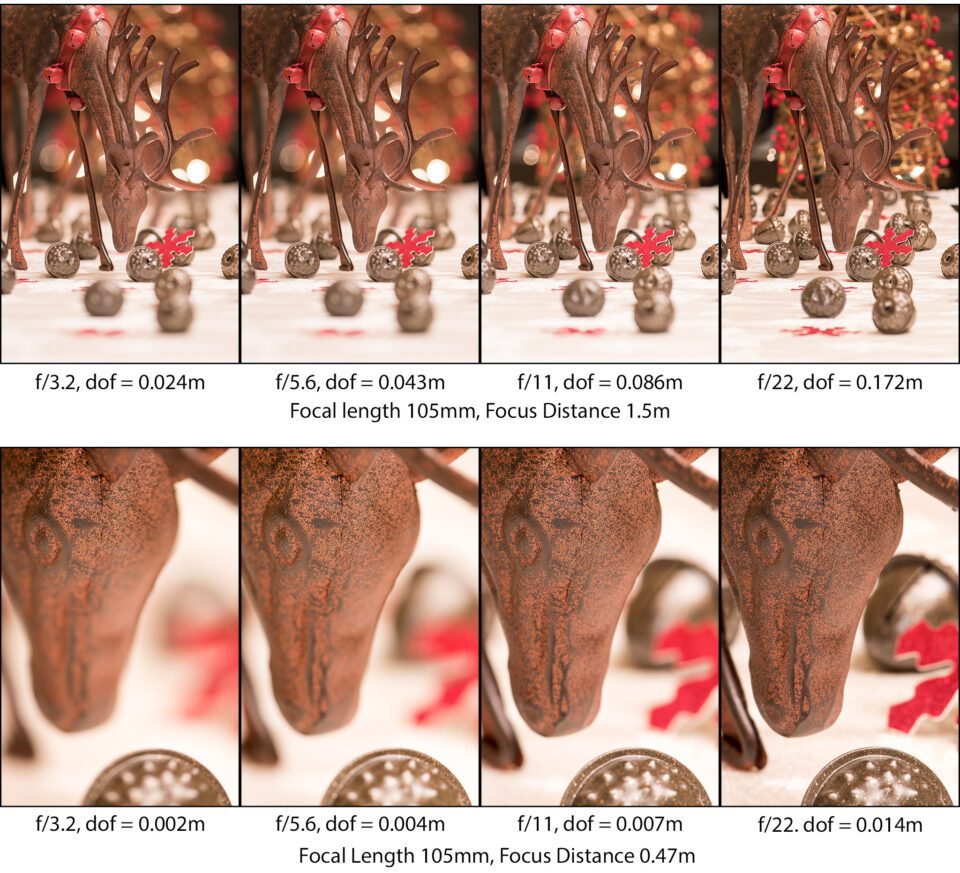
Just a quick notation. A variety of depth of field calculators are available online. You can besides download DoF apps to your phone. All the DoF values mentioned in this article were calculated using the application Simple DoF Calculator for my iPhone. If you are interested in the actual formulas for computing depth of field, you tin observe them here.
Focal Length of the Lens
Wide-angle lenses (short focal lengths) have a deeper depth of field than telephoto lenses (long focal lengths). Well, not exactly! Information technology isn't quite as cut and dry every bit that. If y'all take an epitome and do non change the photographic camera-subject distance, this is true. You can see this illustrated in these two sets of images beneath. The peak set is shot at a focal length of 70mm. The lesser set at 105mm. Both sets were taken at a distance of 2m from the subject area. Find how for each pair of images shot at the same discontinuity, the DoF is larger for the narrower focal length lens.
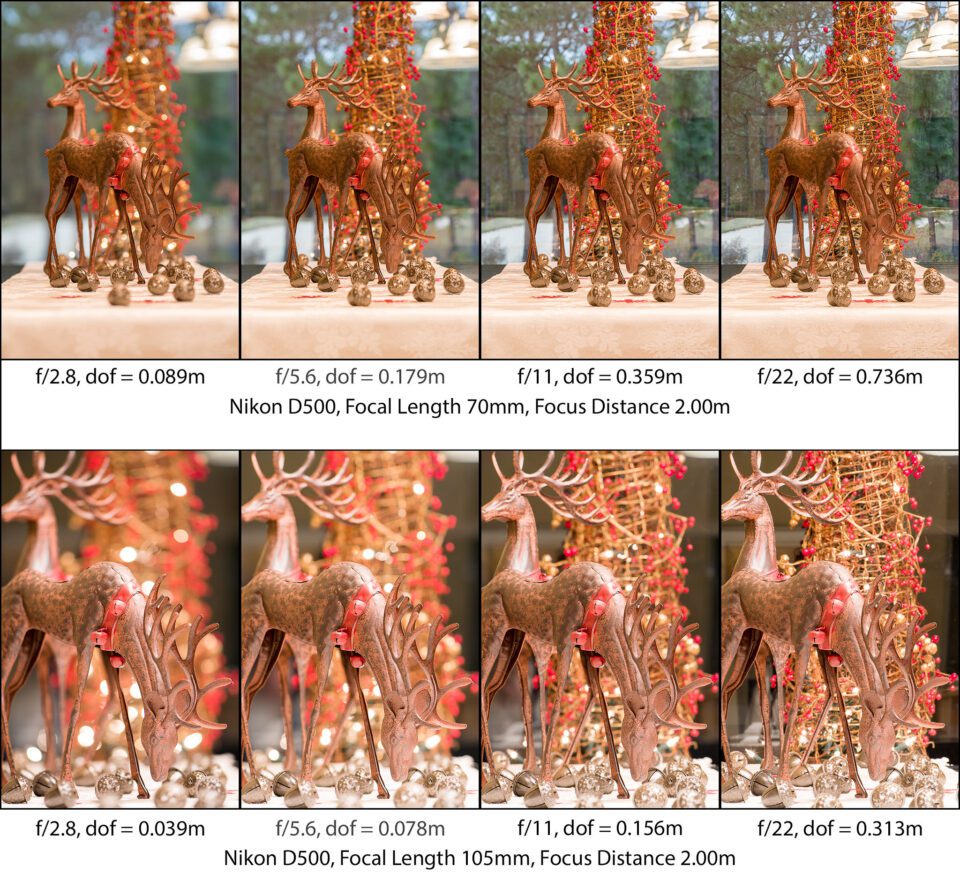
However, it isn't fair to compare these ii sets of images. The field of view in each collection is very different. The height group of images has taken in much more of the surroundings, and the reindeer are much smaller in the frame.
To make the comparison fair, I took two more shots. The first was taken at a focal length of 35mm and approximately 0.6m away from my focus point (still the eye of the nearest reindeer). For the second image, I moved the camera back, so it was 1.2m away from the subject. Then I zoomed into 70mm and framed the shot and so that the caput of the deer was approximately the same size and location as in the first shot. It turns out the DoF in both these images is the same. You can see this looking at the acorn in front of the deer'southward nose and the snowflake and acorn just behind the nose. In both images, they are as sharp.
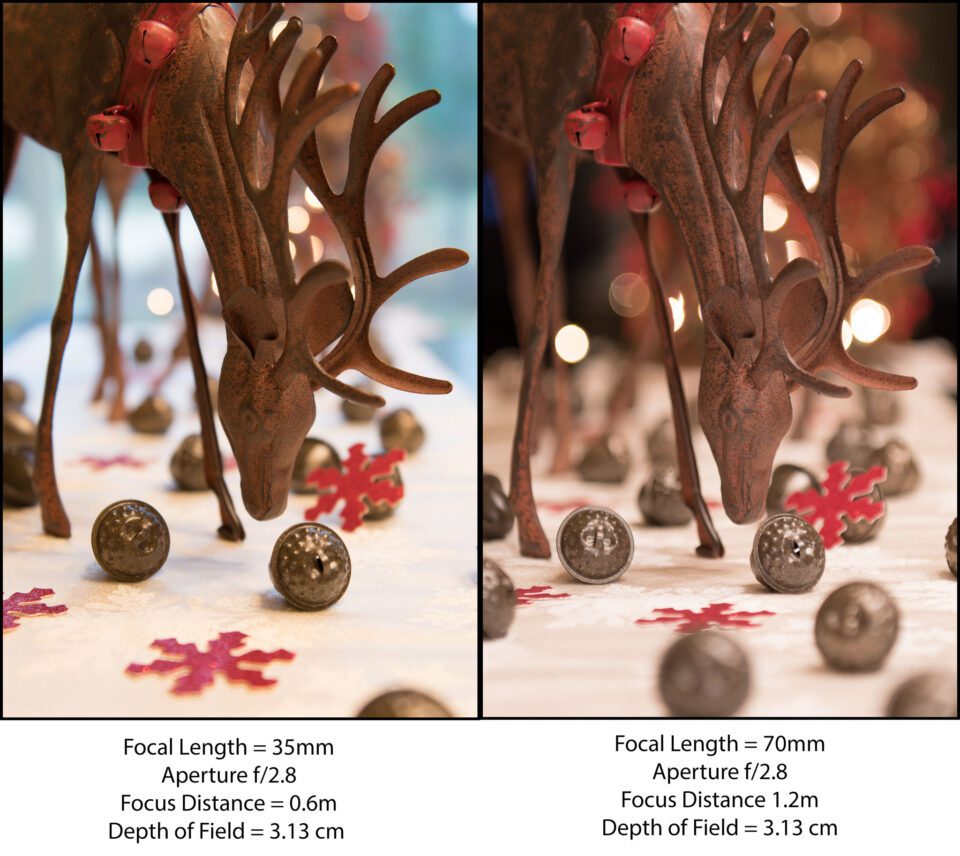
So why practice the ii shots look different? Well, two reasons. The offset has cypher to practice with depth of field. I'm afraid that while I was composing and shooting, the dominicus went downward! So, y'all must ignore the fact that the background is darker in the 2d photo. I do apologize for this! Autonomously from that, the difference lies in the fact that the longer focal length has a narrow angle of view. Thus, a smaller portion of the background fills the frame. The apparent magnification of the background gives the sense that the blur is larger in the photo shot with the longer lens. My commodity "What is Lens Compression and How to Apply It In Your Photos" talks about this in more detail.
Then focal length does not actually influence DoF if yous adjust the camera-subject distance so that the magnification of your subject is the same.
Sensor Size
Sensor size besides affects depth of field. The commodity "Sensor Size, Perspective and Depth of Field" goes into quite a bit of detail on this topic. Then for more of an explanation follow the link.
In a nutshell, cameras with smaller sensors take larger depths of field. However, you have to exist careful how you make the comparison. Yous must look at cameras with lenses that have the aforementioned effective focal length then that the fields of view are the same. If you shoot at the same camera-subject field distance, with the aforementioned apertures, you will discover that the larger sensors have a shallower DoF. That is why many professional portrait photographers similar to use total frame cameras. Here is an example. A full frame camera with a 120mm lens, an APS-C camera with an 80mm lens, and a Micro 4/3 photographic camera with a 60mm lens (nonetheless field of view) are each set to an aperture of f/9 and a camera-subject area distance of 5.0m. This tabular array summarizes how the DoF volition look in each prototype.
| Camera | Crop Cistron | Physical Focal Length | Constructive Focal Length* | Aperture | DoF |
|---|---|---|---|---|---|
| *Constructive Focal Length = Concrete Focal Length x Crop Factor | |||||
| Full Frame | 1.0 | 120mm | 120mm | f/nine | 0.92m |
| APS-C | 1.v | 80mm | 120mm | f/9 | 1.42m |
| Micro 4/iii | 2.0 | 60mm | 120mm | f/9 | 1.91m |
A common question though is tin you take like images, with the aforementioned DoF'due south, using cameras with different sensor sizes? The answer is yes. Still, you must divide the apertures past the ingather factor in social club to get the same depth of field. Using the same cameras and lenses in the above example, but setting an aperture of f/eighteen on the full-frame camera, f/12** on the APS-C sized sensor and f/nine on the Micro 4/3 photographic camera, you will end upwardly with images that non only take in the aforementioned field of view but take approximately the same DoF.
| Camera | Crop Gene | Physical Focal Length | Effective Focal Length* | Physical Discontinuity | Effective Aperture** | DoF |
|---|---|---|---|---|---|---|
| *Effective Focal Length = Physical Focal Length x Crop Cistron **Effective Discontinuity = Discontinuity x Crop Cistron *** although f/12 would be the mathematically correct physical aperture, you would have to select either f/11 or f/13 on your camera. | ||||||
| Full Frame | 1.0 | 120mm | 120mm | f/eighteen | f/18 | 1.89m |
| APS-C | 1.5 | 80mm | 120mm | f/12*** | f/eighteen | ~1.91m |
| Micro 4/3 | two.0 | 60mm | 120mm | f/9 | f/xviii | 1.91m |
Determining Depth of Field
Many DSLR'southward have a depth of field preview push. If you lot press this push button while you look through the viewfinder, the photographic camera will end downwards the lens, and you lot will see how the actual image will look. However, at small apertures, the viewfinder will become very nighttime, and it volition exist hard to come across the preview!
Live view can also be used on some photographic camera models to preview how the DoF will expect. Cheque your educational activity manual to see if your DSLR tin can do this.
Mirrorless shooters potentially have an reward over DSLR shooters because what they come across through the digital viewfinder, or on the LCD is how the photo will typically look.
Conclusion
In my stance, it is not worth getting hung up over how many inches the DoF is in a moving picture. That would completely accept away from the enjoyment of photography. It is much more of import to know when you need a modest DoF and how to create information technology. And the same is true when yous need a large DoF. The beauty of digital is that you tin take a shot, and then review it on the LCD. Quickly reviewing your image is much easier than pulling out your phone and computing DoF! If you don't become the result you are looking for, alter your camera-subject distance or the lens aperture to become the desired effect.
To achieve a shallower DoF you tin either move closer to your discipline or open up your aperture. For greater DoF, motion away from your discipline or close down your aperture. You tin also apply a longer focal length to achieve a 'perceived' shallower depth of field.
Understanding what factors affect the depth of field in a photograph will requite y'all the artistic freedom to make the images y'all desire to create. You will acquire the virtually from practicing. Have time to experiment with your photographic camera; get to know it better. Effort different focal length lenses, change apertures, move your anxiety to alter your perspective. Analyze your photographs and so you know how your gear performs. And so when information technology comes time to take pictures that really count, you lot volition be gear up.
deatheragethessid.blogspot.com
Source: https://photographylife.com/what-is-depth-of-field
0 Response to "Wat Is Depth in Terms of Measurement of Art"
Post a Comment